



















Taking a detailed look at hospital admissions, readmissions, and costs associated with chronic obstructive pulmonary disease in England, 2022-2026.

This article was initiated and funded by AstraZeneca UK. The data presented in this article were commissioned, funded, and compiled by AstraZeneca. The article was developed and written collaboratively by AstraZeneca and Professor Richard Russell.
Around half a million admissions, £1.4bn total costs, and 59 per cent readmitted within 12 months: the scale of England’s chronic obstructive pulmonary disease (COPD) crisis1
Our analysis quantified the significant burden of hospitalisations linked to COPD in England between April 2022 and March 2026. Our findings, based on analysis of Hospital Episode Statistics (HES) data, show that between April 2022 and March 2026:
- 269,346 patients experienced a COPD hospital admission.
- Average length of stay was 6.4 days per admission.
- The total number of hospital spells was nearly half a million.
- Total admission costs were around £1.42bn.
- Admissions clustered in winter and among patients from deprived areas.
- 23.4 per cent of all admissions were patients of working age (working age defined as 16-64).
An additional longitudinal analysis of patients who were hospitalised for COPD in 2023 found that:
- Around 59 per cent of patients admitted for COPD in 2023 were readmitted within 12 months – at a total all-cause readmission cost of £538.5m.
These findings demonstrate a substantial clinical and financial burden associated with COPD and underscore the urgent need for proactive disease management, optimised treatments, and targeted interventions to reduce hospitalisations. This is particularly important for NHS winter preparedness, given the strong seasonal impact on COPD admissions.
An opportunity to reduce the burden of long-term conditions
COPD affects up to 4.9 per cent of England’s population2. In 2019-20, hospitalisation rates for COPD were 642 for every 100,000 people, predominantly among those older than 653.
Older age and socioeconomic deprivation may increase risk of hospitalisation 4,5, but recent large-scale data on hospitalisation rates are limited. To address this gap, we conducted a detailed analysis to quantify England-wide hospitalisation numbers and associated costs and the influence of patient age and deprivation levels.
Method
This analysis draws on HES data, which captures patient care information from NHS hospitals in England, including demographics, diagnoses, and procedures. We conducted two retrospective analyses: a cross-sectional analysis of non-elective COPD hospitalisations between April 2022 and March 2026, and a longitudinal analysis tracking readmissions for a cohort of patients admitted for COPD in 20231.
A COPD “spell” was defined as any non-elective inpatient admission where the primary diagnosis included an acute exacerbation of COPD (AECOPD). We estimated admission costs using Healthcare Resource Group reimbursement guidelines, and patient data were categorised by the 2019 Index of Multiple Deprivation (IMD) based on the patients’ Lower Super Output Area (LSOA)6.
Key insights from the analysis
Between April 2022 and March 2026, nearly half a million admissions (481,097) for COPD were recorded across 269,346 unique patients. The total cost for these admissions, which averaged 6.4 days per stay, reached around £1.42bn, with annual costs increasing from £310.7m in 2022-23 to £401.6m in 2025-26. This represents a 29 per cent rise in annual expenditure over just three years – a trajectory that, if sustained, will significantly increase the financial burden on the NHS.
At roughly £2,950 per admission, even a modest reduction in COPD hospitalisations through earlier identification, integrated care pathways, and consistent treatment could generate substantial savings for the NHS – while meaningfully improving outcomes for patients.
COPD admissions showed a consistent and predictable seasonal pattern. In each year, winter (December-February) had higher spell activity than the corresponding summer period (June-August): by 9,192 spells (38.2 per cent) in 2022-23, 7,640 (27.8 per cent) in 2023-24, 7,121 (26.5 per cent) in 2024-25, and 8,641 (33.1 per cent) in 2025-26.
In 2023, 86,210 patients had a hospitalisation for COPD and 50,825 (59 per cent) had at least one all-cause readmission within 365 days of their index admission. The most frequently recorded readmission categories within 365 days were “other” causes (41.5 per cent), AECOPD (30.7 per cent), pneumonia (17.6 per cent), and expanded cardiovascular causes (7.8 per cent). These categories were not mutually exclusive because a single hospital spell could contain multiple episodes with different primary diagnoses and could therefore be counted in more than one readmission category.
AECOPD and “other” causes for hospitalisation were associated with high total costs, at £194.8m and £255.8m, respectively (figure 2a), with total all-cause readmission costs of £538.5m over the whole analysis period.
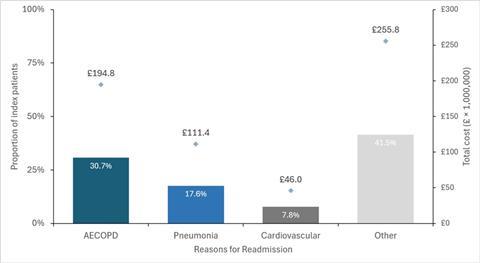 Figure 1. Causes of readmission as proportion of index patients (n=86,210), and associated costs in GBP
The burden of COPD is unequal
Our findings also illustrate the impact of socioeconomic deprivation, with the largest proportion of admissions concentrated among patients in the highest 20 per cent of deprived neighbourhoods (quintile 1), who had 3.42 times as many COPD admission spells as those in quintile 5 (least deprived), contributing significantly to the high associated costs. This highlights the critical need to address socioeconomic factors to achieve greater equity in COPD care.
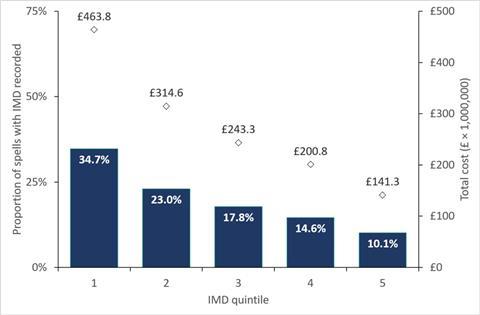
Figure 2. The proportion of total admissions over the April 2022-March 2026 period stratified by IMD quintile for patients with available IMD data (n= 466,676), and associated costs in millions of GBP.
A preventable burden: the case for acting on cost, seasonality, and deprivation
Our analysis shows a substantial burden of COPD on the NHS, with nearly half a million hospitalisations costing £1.42bn. Wider societal costs are likely higher, as almost a quarter of patients were of working age, implying substantial economic and societal burden through lost productivity. This may include time off work, time spent providing care, loss of income, and loss of tax. Patients with COPD frequently have informal caregivers7, adding further societal burden.
Our analysis also highlights the seasonality of COPD-related hospitalisations, consistent with previous reports, likely reflecting AECOPDs driven by winter respiratory infections8. This predictable winter pressure from COPD compounds existing healthcare system strain during winter months.
These findings also expand on a previous study, showing an impact of patient deprivation level on COPD hospitalisation rate5. Most hospitalisations in this cohort were for patients in the most deprived IMD quintiles, with a high associated cost of care. These data show disparities in COPD burden and highlight the need to address socio-economic drivers to ensure improved equity in COPD care.
Improving COPD management represents one of the most tangible opportunities available to the NHS to reduce avoidable hospitalisations, cut costs, and address health inequalities.
Several key initiatives are already underway, including the Respiratory Transformation Partnership (which includes AstraZeneca as a partner, announced March 20269), the inclusion of COPD within the 2026-27 Neighbourhood Health Framework10, best practice tariffs for COPD discharge care11, and new commissioning guidance emphasising proactive, risk-stratified care12. These provide a strong policy foundation; what is now needed is implementation at pace and with equity in mind. Every integrated care system should map COPD admission rates against IMD quintile to identify where intervention is most urgent.
Best practice discharge bundles should become standard care. And winter COPD surge plans should be treated with the same operational seriousness as cardiac or trauma pathways. The cost of inaction is now clearly documented: £1.42bn and rising.
This analysis has limitations. The HES data set was used, and thus accuracy relies on accurate coding of events. Our data begin in April 2022, when NHS activity was still recovering from pandemic-related disruption; admission patterns in the earlier years may partly reflect this recovery, though the consistency of trends across the full four-year period suggests this effect is modest.
Acknowledgements
HES data is reused with the permission of NHS England, copyright 2026. This work uses data provided by patients and collected by the NHS as part of their care and support. All rights reserved. HES data for these analyses were provided by Compufile Systems Limited. Writing and editorial support was provided by Olivera Rajkovic-Hooley, Lucinda Camidge, and Niels Haan of Adelphi Real World, Bollington, UK, funded by AstraZeneca.
Job ID: GB-82092
Date of preparation: November 2026
References
1 AstraZeneca Data on File REF-391251.
2 Stone PW, Osen M, Ellis A, Coaker R, Quint JK. Prevalence of Chronic Obstructive Pulmonary Disease in England from 2000 to 2019. International Journal of Chronic Obstructive Pulmonary Disease. 2023;18:1565–1574.
3 Alwafi H, Naser AY, Ashoor DS, Aldhahir AM, Alqahtani JS, Minshawi F, et al. Trends in hospital admissions and prescribing due to chronic obstructive pulmonary disease and asthma in England and Wales between 1999 and 2020: an ecological study. BMC Pulmonary Medicine. 2023;23(1):49.
4 Mullerova H, Maselli DJ, Locantore N, Vestbo J, Hurst JR, Wedzicha JA, et al. Hospitalized exacerbations of COPD: risk factors and outcomes in the ECLIPSE cohort. Chest. 2015;147(4):999–1007.
5 Collins PF, Stratton RJ, Kurukulaaratchy RJ, Elia M. Influence of deprivation on health care use, health care costs, and mortality in COPD. International Journal of Chronic Obstructive Pulmonary Disease. 2018;13:1289–1296.
6 Ministry of Housing, Communities & Local Government. English Indices of Deprivation 2019.
7 Nakken N, Janssen DJ, van den Bogaart EH, Wouters EF, Franssen FM, Vercoulen JH. Informal caregivers of patients with COPD: Home Sweet Home? European Respiratory Review. 2015;24(137):498–504.
8 Wilkinson TMA, Aris E, Bourne S, Clarke SC, Peeters M, Pascal TG, et al. A prospective, observational cohort study of the seasonal dynamics of airway pathogens in the aetiology of exacerbations in COPD. Thorax. 2017;72(10):919–927.
9 Department of Health and Social Care. Press release: Asthma and COPD patients to receive better care closer to home. 2026. Available at: Asthma and COPD patients to receive better care closer to home [last accessed October 2026].
10 Department of Health and Social Care, NHS England. Neighbourhood health framework. 2026. Available at:Neighbourhood health framework – GOV.UK [last accessed October 2026].
11 NHS England. 2025/26 NHS Payment Scheme – Annex C: Guidance on best practice tariffs. 2025. Available at: NHS England » 2025/26 NHS Payment Scheme – Annex C: Guidance on best practice tariffs [last accessed October 2026].
12 NHS England. Chronic obstructive pulmonary disease: commissioning strategies and resources. 2026. Available at: NHS England » Chronic obstructive pulmonary disease: commissioning strategies and resources [last accessed October 2026].