


















This non-promotional article has been initiated and fully funded by Novartis
In 2025, NHS England published its strategic commissioning framework1. The expectation is clear: Integrated care boards should move from short-term, transactional purchasing to a continuous, evidence-based process focused on population health, reducing inequalities and creating the best value from every pound of NHS expenditure.
The 10-Year Health Plan2, the draft Model ICB Blueprint(05/25)3 and the medium-term planning framework4 all point in the same direction: ICBs acting as value-based payers. In recognition that this shift is challenging in a budget-constrained system, a strategic commissioning development programme is now in place to build the capabilities needed5.
This article is written for everyone involved in commissioning decisions about medicines, not just pharmacists. Strategic commissioning of medicines requires pharmacy expertise, but the governance, financial architecture, and decision-making that determine whether it succeeds sit with system leaders, finance directors, and commissioning executives. If you are responsible for how NHS resources are allocated, this is for you.
Who this article is for
ICB executives and commissioning directors – you set the governance and decision-making frameworks within which medicines commissioning happens. This article asks whether those frameworks are configured for value.
Finance directors and chief finance officers – medicines are the largest non-staff spend in the NHS. This article argues that the financial architecture for medicines decisions is incomplete, and that you hold the key to fixing it.
Chief pharmacists and medicines optimisation leads – you have the clinical expertise and system understanding to lead value-based medicines commissioning. This article provides a framework for making that case and the practical steps to act on it.
Clinical leaders and medical directors – medicines decisions shape pathways, capacity, and patient outcomes across your services. This article makes the case for clinical leadership in commissioning, not just clinical input.
Provider pharmacy teams – you generate the real-world data and see the downstream consequences of commissioning decisions every day. This article shows how that expertise can drive system-level change.
For those of us working with medicines, this shift presents an opportunity to focus on longer-term value while improving system-wide productivity. But it also demands honesty about why the NHS sometimes fails to adopt high-value medicines, even when the evidence is clear of the broader impact these can have on pathway inefficiency, outpatient capacity, and waiting lists. Anyone who has attended a formulary meeting where the clinical case for a medicine was strong, but the conversation still defaulted to “what does it cost per unit?” will recognise the gap. The answer is rarely weak science or clinical disagreement. It is that the system’s current lens on acquisition cost, switching targets, and budget-line compliance does not make total pathway value visible at the point where commissioning decisions are made. Decisions fragment across budgets and committees, and value is often known by clinical experts but has no mechanism to enter the commissioning conversation.
Anyone who has sat in a budget meeting knowing the numbers don’t add up or defended a prescribing decision to a finance director who sees only the medicine cost line will recognise the pressure. Budget holders and decision-makers working within finite resources, facing immediate pressures, accountability scrutiny, and imperfect information, are being asked to invest today for returns that may take years to materialise. That takes courage, and the system does not always reward it. But the pattern of clinical advocacy met by cost-driven resistance, followed by eventual capitulation, is the opposite of strategic commissioning.
We’ve done this before
We have seen this before. When direct oral anticoagulants arrived, the preference for warfarin lasted longer than the evidence warranted. Warfarin required regular international normalised ratio monitoring and counselling time, carried additional bleeding risk and increased the risk of drug-drug interactions6. Clinicians advocated for treatments with an improved safety and efficacy profile; commissioners resisted on cost. Eventually the evidence prevailed. The value was clear, not just clinically, but across the whole pathway: fewer monitoring appointments, fewer bleeds, fewer hospitalisations. That value was always there. Value was recognised by clinicians, but commissioning structures did not enable it to shape the decision at the time.
The same story played out with older antiobesity medicines and the GLP-1 receptor agonists. GLP-1 receptor agonists represented a step change in efficacy, with cardiovascular, renal, and metabolic benefits that evidence increasingly supports7. The initial resistance was cost-driven. It happened again with older antipsychotics and atypicals: higher medicine cost, but significantly fewer extrapyramidal side effects, better adherence, and quality of life8. Evidence suggests that delayed adoption was associated with prolonged exposure to avoidable side effects. And with statins: clear evidence of cardiovascular event reduction existed with high-intensity formulations long before the price dropped9. In each case, clinical experts advocated, but cost-driven resistance delayed adoption, and eventual capitulation proved the value case had been there all along.
This matters now because the same dynamic is playing out in newer and innovative medicines. Medicines are the largest single area of NHS spend after staffing10. Biological medicines represent eight of the top 10 hospital medicines by cost11. The best value biological medicines framework has driven significant savings: the adalimumab programme alone saved an estimated £400m more than three years11, and the biosimilar agenda remains essential. But a system that defaults to the cheapest biologic without considering total pathway value is making the same structural error that delayed DOACs and GLP-1s, just in a different therapeutic context. The question is not whether biosimilars should be adopted where clinical equivalence holds. They should. The question is whether the system can recognise the situations where a higher-acquisition-cost medicine delivers better total value, and act on that recognition proactively, rather than waiting for clinicians to force the change.
In several major specialties, outpatient demand is not simply associated with medicines; it is created by them. In several major specialties, outpatient demand is driven by repeated biologic injections and infusions, illustrating how medicines decisions directly shape system capacity and demand.
Some innovations face legitimate questions about comparative value. Some present a compelling case, but at a scale the system cannot yet afford. And some represent clear value that is recognised by clinicians but not yet operationalised in commissioning decisions. This article is about that third category: innovations where the evidence and the value case exist, but the commissioning system has not yet found a way to act on them. Our central argument is that value decisions must be built into commissioning processes, not treated as a separate conversation from finance. If those conversations are happening in different rooms, the system is structurally incapable of commissioning for value.

Existing optimisation approaches prioritise rule compliance and short-term affordability, but offer no mechanism for integrating clinical outcomes, financial flows, and system impact into a single judgement12. The model for value-based strategic commissioning of medicines, developed by the authors from collective experience across commissioning, provider pharmacy and system leadership, is not proposed as a new toolkit but as a corrective to that gap. In practice, two elements matter most: mindset and financial competence. Without them, the remaining capabilities default to compliance rather than strategic judgement.
Equally, strategic commissioning should not be assumed to favour higher-cost interventions. In many circumstances the highest-value decision will be a biosimilar, generic medicine, deprescribing initiative, pathway redesign or non-pharmacological intervention. The objective is not higher spend or lower spend, but better value.
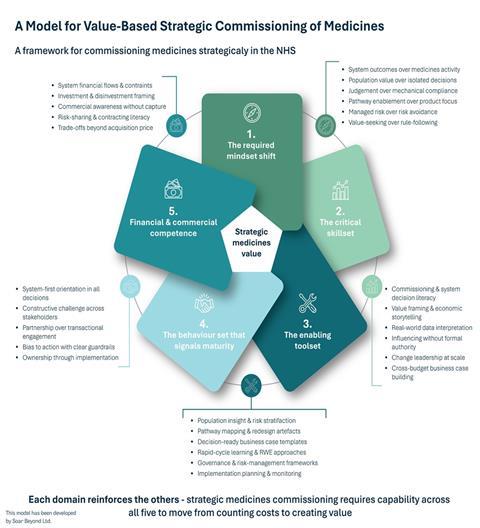
The required mindset shift
This is not about blaming ICBs; it is about equipping them. Most are working hard to do the right thing for their populations. But in real-world decision-making, in formulary meetings and budget discussions, the system does not always provide the information, financial visibility or framework needed to judge value at the point of commissioning.
Evidence is not always black and white. Commissioners often must make calls on the balance of probability. A system that only acts on certainty will always be late to value. The mindset shift means getting comfortable with well-evidenced judgement calls, supported by clear guardrails and a commitment to monitoring outcomes.
We recognise this is easier to write than to do. Defending a higher-cost prescribing decision to a finance director who sees only the budget line, or advocating for a medicine that won’t show returns for two years in a system measured quarterly – these carry real professional risk. But the practical shift is specific. When a new medicine reaches formulary committee, the first question should not be “what does it cost?” but “what population need does this address and what is the total pathway value of meeting that need differently?” When reviewing existing prescribing, the question is not “are we on the cheapest option?” but “are we getting the outcomes we expected, and where is value being gained or lost?”
Mindset shift: Three actions
- Reframe one formulary decision this quarter as a pathway value question. Take a medicine currently positioned on acquisition cost and ask: what is the total cost to the system of the current approach – including outpatient appointments, switching burden, treatment failure, and patient experience? Present the comparison to your committee.
- Introduce a value hypothesis into every new medicine assessment. Before any formulary decision, require a one-page statement: what patient, population and system outcomes do we expect, and how will we know if they are being delivered? If the only metric is medicine spend, the decision is incomplete.
- Audit one existing pathway for hidden cost. Pick a therapeutic area where switching or treatment failure is common. Quantify the downstream resource consumed – specialist reviews, monitoring, loading doses, follow-up. Use this as the evidence base for a different conversation.
Financial and commercial competence
A good clinical argument alone is not sufficient to drive adoption of medicines that deliver value for systems. It will fail unless it can also be translated into the language of investment, return, and risk. Pharmacy teams need to understand how the money flows and work collaboratively with commissioning colleagues: how high-cost medicine budgets interact with tariff payments and acute contracts, how gainshare works, and why a cost on the prescribing budget may generate a saving on the acute provider’s outpatient budget that never flows back to the commissioner.
This cross-budget challenge is at the heart of many “no-brainer” decisions that do not happen. Pharmacy teams must be equipped to make the cross-system investment case, framing investment and disinvestment as two sides of the same coin.
The practical implications are specific:
- Know when the ICB’s financial planning cycle begins. If investment cases are not embedded before budgets are set, they wait 12 months.
- Model a cross-budget business case showing the net position across prescribing, acute outpatient, and community budgets, not just the pharmacy line.
- Understand how provider contracts are structured so that savings generated by better prescribing are visible to the commissioner.
- Present investment cases to finance directors as financial propositions using the language of net budget impact, cost avoidance, and return on investment – not as clinical requests.
Looking ahead, there is a structural challenge the system must address. NHSE delegates commissioning responsibility to ICBs but does not always delegate the commercial tools needed to exercise it. Risk-sharing and outcomes-based contracting offer real potential. In every other sector, significant purchases come with guarantees and shared accountability. If NHSE wants ICBs to commission strategically, it must also consider giving them the flexibility to negotiate and construct local value arrangements.
Financial competence: Three actions
- Map the cross-budget flow for one high-cost medicine. Identify where the prescribing cost sits, where the downstream savings accrue (acute outpatient, diagnostics, community), and whether your current financial reporting makes both visible. If it doesn’t, that’s the first conversation to have with your finance director.
- Align to the ICB financial planning cycle. Find out when your ICB submits its financial plans. Build and submit your medicines investment cases before that deadline, not after. A value case that arrives after budgets are set waits 12 months.
- Present one investment case as a financial proposition, not a clinical request. Use the language of net budget impact, cost avoidance, and return on investment. Show the numbers across budget lines. Finance directors respond to investment cases; they defer clinical requests to clinicians.
The supporting capabilities
The remaining domains of skillset, toolset and behaviour set tend to develop once mindset and financial literacy are in place. Commissioning literacy, economic storytelling, real-world data interpretation, population segmentation, pathway mapping and rapid-cycle evaluation are the standard infrastructure of any commissioning function. What has been missing is the mindset and financial confidence to apply them to medicines.
The behaviour set is where clinical leadership becomes critical. Value-based commissioning should be clinically led or dual-led. The professionals who understand patient need and experience firsthand the consequences of suboptimal treatment must be co-architects of the value framework, not consultees after financial parameters are set.

If strategic commissioning is to move beyond acquisition cost, commissioners need a practical understanding of where value is created, and lost, in pathways. The following three value lenses are not tied to any specific medicine or therapeutic area. They apply wherever treatment decisions are made, and they illustrate the kind of thinking that should be present in every commissioning conversation about medicines.
Value Lens 1: Treatment persistence and the cost of switching
When a biologic treatment fails or loses effectiveness, the consequences extend well beyond the pharmacy budget. Each treatment switch typically triggers a sequence of activity: specialist review, shared decision-making with the patient, updated baseline monitoring, a new loading or titration phase, and follow-up assessments to evaluate response. In services already under pressure from elective backlogs, these appointments compete directly with capacity for new patients.
Beyond the service burden, there is clinical uncertainty. A switch carries no guarantee of response, and patients may experience a period of inadequately controlled disease while waiting to see whether the new treatment works, with all the associated risk of disease progression. For patients, this means uncertainty, additional hospital visits, and the psychological toll of treatments that do not deliver sustained benefit.
A strategic commissioner would ask: where biologics with different mechanisms of action or stronger persistence profiles exist, does investing in a higher-acquisition-cost option that keeps patients well for longer reduce the total pathway cost? If switching is common, what is the true system cost of that switching – not just the drug cost, but the clinical capacity consumed, the monitoring required, and the outcomes foregone?
Value Lens 2: Dosing optimisation and capacity creation
Some biologics require frequent administration, in some cases as often as every four weeks, generating significant and sustained demand on clinic capacity. Where newer formulations or treatment protocols enable extended dosing intervals, the system implication is direct: every appointment that is safely avoided releases a clinic slot.
The strategic commissioning question is what happens to that freed capacity. In a service with a significant waiting list backlog, those slots can absorb unmet demand, reducing waiting times, improving access, and addressing health inequalities in populations disproportionately affected by delayed treatment. In a service performing well against its referral-to-treatment targets, the freed capacity can be redeployed for additional elective activity. Either way, the value extends well beyond the pharmacy budget line.
However, capacity benefits do not materialise automatically. Services that redesign pathways, agree clinical protocols, and actively monitor interval extension are more likely to realise these gains than those that simply adopt a higher-cost medicine without changing how the service is delivered. Commissioning for value means commissioning the implementation, not just the medicine.
Value Lens 3: Prevention, early intervention and downstream avoidance
Effective biologic treatment earlier in a disease pathway can prevent complications that generate significant downstream cost. Uncontrolled disease, for example, can lead to hospitalisations, surgical interventions, workforce absence, and long-term disability, all of which consume system resources that could have been avoided.
Strategic commissioning would ask: what is the cost of undertreating this patient population now, measured not just in clinical outcomes but in emergency admissions, surgical activity and long-term care needs? If a more effective biologic, initiated earlier, reduces the probability of these downstream events, the total system investment may be lower than the apparently cheaper alternative that allows disease to progress.
This aligns directly with the broader NHS shift towards prevention and early intervention. The cheapest biologic that fails is more expensive than the effective one that works first time. The cost simply appears in a different budget, at a different time, and is rarely attributed back to the original prescribing decision.
These three lenses are not exhaustive, but they illustrate the gap between acquisition cost and pathway value. Strategic commissioning requires all three to be visible at the point of decision.
When does higher cost equal higher value? Four conditions
- The evidence supports it. Published data, real-world studies, and clinical guidelines point to better outcomes; not just clinical endpoints but patient experience, functional status, and downstream resource use.
- It is implemented well. A higher-cost medicine may require pathway redesign, clinical protocols, or service change to deliver its full value. Commissioning for value means commissioning the implementation, not just the medicine.
- Outcomes are monitored. Treatment persistence, switching rates, clinic use, and patient-reported outcomes are tracked from the outset. If the expected value is not materialising, the commissioning decision should be reviewed, in real time, not at formulary renewal.
- Alternatives have been considered. Strategic commissioning requires comparison with all credible options, including lower-cost medicines, biosimilars, service redesign, and non-pharmacological approaches. Value can only be judged relative to the available alternatives.

A formulary decision without a value hypothesis is not a strategic commissioning decision. If the only metric tracked after a commissioning decision is medicine spend, the system has no way of knowing whether its investment is delivering returns. The model for value-based strategic commissioning of medicines offers a corrective to how we currently commission medicines. But only if the system adopts it as a set of essential practices, not an aspiration.
Using existing authority more strategically
Pharmacy and medicines optimisation teams are ideally placed to lead this work. The opportunity is not to wait for permission, but to use existing influence more strategically in commissioning decisions. The unique combination of clinical expertise and system understanding – a pharmacist prescriber who understands both the evidence for a higher-value biologic and the cross-budget dynamics of prescribing-versus-acute costs, makes a qualitatively different contribution to commissioning conversations. That contribution should carry commensurate authority. Practically, this means integrating pharmacy into decision-making earlier, using shared meeting structures, and assigning explicit ownership for value hypotheses within existing governance.
But this is not just a pharmacy challenge. If strategic commissioning of medicines is left to pharmacists alone, it will not succeed. It requires system leaders, finance directors, and all commissioners to configure their governance, financial architecture, and decision-making processes to enable it. If clinical and financial conversations happen in separate meetings, if the prescribing budget is treated as a standalone cost line, the system is not commissioning strategically, regardless of what the strategy document says. We encourage all commissioners to draw on the expertise of their pharmacy colleagues in making these decisions.
The conversations that need to happen
- Pharmacy and finance must be in the same room for medicines commissioning decisions. If your ICB makes formulary and prescribing decisions in a clinical meeting and budget decisions in a finance meeting, value cannot be assessed. Bring them together – one meeting, one decision framework, one shared accountability for outcomes.
- Chief pharmacists need a seat at the commissioning table, not a seat in the waiting room. If pharmacy input comes after financial parameters are set, it is too late. Medicines expertise must shape the value framework from the outset, not validate a cost decision after the fact.
- Agree one “no-brainer” test case and run it end to end. Every system has at least one medicine where the value case is strong, but adoption has stalled. Pick it. Convene pharmacy, finance, commissioning, and clinical leads around it. Apply the model for value-based strategic commissioning of medicines. Build the case, make the decision, monitor the outcomes. Use it as proof of concept for how strategic commissioning of medicines should work.
A call to action
Building value assessment into every commissioning decision is not optional. It is the defining characteristic of strategic commissioning. Without it, we risk repeating history. World-class commissioning was launched with similar ambitions in 2007 and changed very little, because the architecture did not match the rhetoric13. The strategic commissioning framework must not suffer the same fate. The difference this time will be whether ICBs and their teams can move beyond aspiration to embedded practice, with the governance, the financial tools, and the clinical authority to make value-based decisions routine.
The NHS has done this before. Every time, the value was known by those closest to patients but was not acted on at the point of commissioning until resistance gave way. The model for value-based strategic commissioning of medicines defines what the system needs: the mindset to ask the right questions, the financial literacy to model the answers, the clinical leadership to hold the system accountable, and the courage to act on sufficient evidence rather than waiting for certainty. The tools, the policy framework, and the commissioning mandate are all in place. What remains is the will to ensure the next value-based transition happens by design, not by default.
References
- NHS England. Strategic commissioning framework. https://www.england.nhs.uk/publication/nhs-strategic-commissioning-framework/
- Fit for the Future: 10YHP for England. NHS England » Fit for the Future: 10 Year Health Plan for England
- Update on the draft Model ICB Blueprint and progress on the future NHS Operating Model. https://www.england.nhs.uk/long-read/update-on-the-draft-model-icb-blueprint-and-progress-on-the-future-nhs-operating-model/
- Medium Term Planning Framework – delivering change together 2026/27 to 2028/29. https://www.england.nhs.uk/long-read/medium-term-planning-framework-delivering-change-together-2026-27-to-2028-29/
- NHS Elect. Strategic Commissioning Development Programme. nhselect.nhs.uk/improvement-collaboratives/Team-and-leadership-development/Strategic-commissioning
- NICE. Atrial fibrillation: diagnosis and management. NG196. 2021. nice.org.uk/guidance/ng196
- Sattar N, Lee MMY, Kristensen SL, et al. Cardiovascular, mortality, and kidney outcomes with GLP-1 receptor agonists in patients with type 2 diabetes: a systematic review and meta-analysis of randomised trials. Lancet Diabetes Endocrinol. 2021;9(10):653–662.
- Gao K, Kemp DE, Ganocy SJ, et al. Antipsychotic-induced extrapyramidal side effects in bipolar disorder and schizophrenia: a systematic review. J Clin Psychopharmacol. 2008;28(2):203–209.
- Cholesterol Treatment Trialists’ (CTT) Collaboration, Efficacy and safety of more intensive lowering of LDL cholesterol: a meta-analysis of data from 170 000 participants in 26 randomised trials, The Lancet, 2010; 376, 1670-1681.
- NHS England. Medicines Value and Access. england.nhs.uk/medicines-2/medicines-value-and-access/
- NHS England. Commissioning framework for best value biological medicines. 2022. england.nhs.uk
- National Institute for Health and Care Excellence (NICE). Medicines optimisation: the safe and effective use of medicines to enable the best possible outcomes. NICE Guideline [NG5]. Published 4 March 2015. Available at: https://www.nice.org.uk/guidance/ng5
- Department of Health. World Class Commissioning: Vision. London: Department of Health; December 2007. World class commissioning (WCC) programme – Health Navigator
Job code: FA-11712881
Date of preparation: August 2026
Source Date