


















The NHS does not lack ambition. Across the country, clinicians, managers, patients, charities, and industry partners can see what needs to change.
Initiated and funded by GSK and delivered with HSJ Information. Article written and paid for by GSK.

The harder question is how we create the conditions for good ideas to move beyond pilots, individual champions, and short-term projects into sustained improvement at scale.
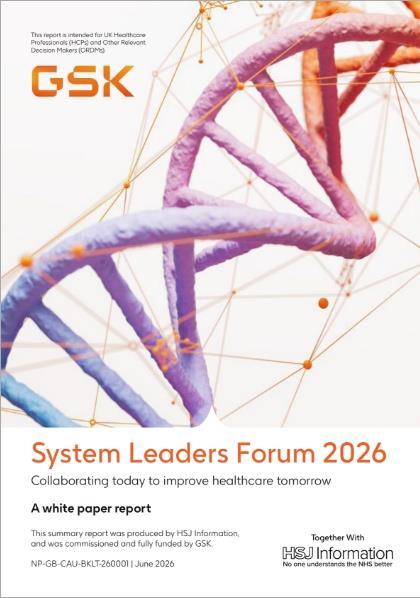
That is why the System Leaders Forum, initiated and funded by GSK and delivered with HSJ Information, was timely. It brought together senior NHS leaders, respiratory clinicians, patient representatives, charities, and industry partners to consider how respiratory care could be redesigned around earlier diagnosis, prevention, population health, and better use of system-wide capability.
Respiratory disease is a powerful test of how well integrated care is working. The SLF white paper highlights that respiratory disease is the third biggest cause of death in England, while respiratory conditions remain the leading cause of emergency hospital admissions in the UK. Asthma and chronic obstructive pulmonary disease alone carry an estimated annual economic burden of around £4.9bn. COPD affects around 3 million people in the UK, yet more than half of those living with the condition are thought to be undiagnosed.
The inequalities are equally stark. Five of the 15 highest mortality inequalities in England relate to respiratory conditions. Emergency COPD admissions are also heavily concentrated in more deprived communities, with 41,540 admissions in the most deprived quintile compared with 12,550 in the least deprived. These figures reflect late diagnosis, inconsistent access, variation in care, and missed opportunities to intervene before patients reach crisis point.
For senior system leaders, the message is clear. Respiratory care is not a niche clinical concern. It is a system performance issue, a health inequalities issue and a population health opportunity. The current model still leaves too many patients diagnosed late, treated inconsistently and supported only when their condition deteriorates. Incremental improvement will not be enough.
The forum reinforced that many of the solutions are already known. Earlier case finding, high-quality spirometry, risk stratification, optimised treatment, pulmonary rehabilitation, inhaler technique support, community pharmacy, virtual wards, and better post-discharge care all have a role. The challenge is to connect these interventions into a coherent pathway, delivered consistently across neighbourhoods, primary care, community services, acute providers, and local partners.
This is where purposeful collaboration with industry can add real value. Industry cannot and should not set NHS priorities. However, it can bring project capacity, analytical expertise, implementation support, evidence generation, digital capability, and funding for carefully governed pilots. The strongest partnerships are built around shared system problems, agreed outcomes, patient benefit, and clear governance.
The investor pitch session was one of the most valuable elements of the forum. It moved the conversation from describing pressure to designing solutions. Delegates were asked to develop credible models of care, consider workforce and data requirements, think through funding and delivery, and present their ideas to an investor panel. This format created energy because it made implementation part of the discussion from the start.
The outputs were practical and relevant to real system pressures. One group proposed a five-year primary care risk stratification model to identify high-risk COPD patients, optimise treatment and close the diagnostic gap. Another set out a community-based respiratory hub model, including outreach into neighbourhoods and stronger links between patients, charities, primary care, specialists and industry. A third focused on avoiding readmissions through digitally enabled COPD care bundles, virtual wards and respiratory champions embedded in primary care networks.
What stood out to me was not only the quality of the ideas, but the discipline of the process. Leaders were given space to think creatively, but also had to consider delivery, measurement, and sustainability. That is often the missing link in system transformation. We talk about innovation, but the harder work is building the conditions for adoption, spread, and accountability.
For NHS and industry collaboration to work well, it must be grounded in trust, transparency and shared purpose. It must involve patients from the start, align with commissioner priorities, include finance colleagues early, and focus on outcomes that matter to both patients and the system. It also requires industry partners to understand the NHS context and support implementation in a way that is relevant, proportionate and credible.
Call to action for senior system leaders
- Treat respiratory care as a system priority, not a series of disconnected service improvement projects.
- Use data to find patients earlier, particularly those at highest risk, those undiagnosed and those living in communities with the greatest burden of disease.
- Move from pilots to scalable pathways, with clear governance, workforce plans, funding routes, and measurable outcomes.
- Bring finance, clinical and operational leaders together early, so pathway redesign is matched by sustainable financial planning.
- Work with industry where there is a clear shared objective, strong governance, patient benefit, and a credible route to scale.
- Protect the patient voice, ensuring models of care reflect lived experience, access barriers and what matters to people managing long-term respiratory disease.
The opportunity is to act with focus and shared responsibility, building respiratory care that finds people earlier, treats them consistently and supports them closer to home.
To read the full report, click here.
Job code: NP-GB-CAU-WCNT-260001
Date of preparation: July 2026