




















This article summarises findings from the Time to Breathe roundtable, a Boehringer Ingelheim-funded and commissioned initiative involving respiratory clinicians, commissioners, service leads and patient organisation representatives. Participants were compensated for their time. The article has been developed independently by Boehringer Ingelheim and reflects the discussions and recommendations arising from that roundtable discussion.
Mortality that cannot be ignored
Mortality remains a critical outcome in interstitial lung disease (ILD), particularly in idiopathic pulmonary fibrosis (IPF) and progressive pulmonary fibrosis (PPF), where progression can be rapid and unpredictable. In IPF, median survival is commonly reported at just three and five years after diagnosis, and pooled analyses report a five-year cumulative survival rate of 45.6 per cent (Figure 1)[1]. For context, this is lower than reported five-year survival for several common cancers, including breast, prostate and colon cancer;[2] these comparisons are illustrative rather than a standalone commissioning metric, but they underline the scale of unmet need (Figure 2).
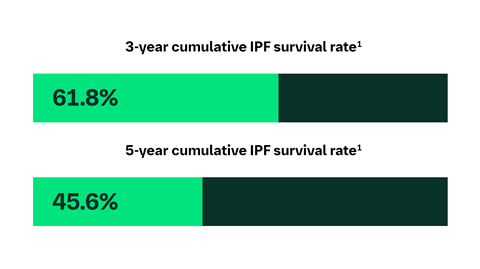
Figure 1: IPF cumulative survival falls below 50 per cent by five years.
Five-year cumulative survival estimate (45.6 per cent) derived from an international systematic review and meta-analysis of IPF studies published up to 2021.
IPF mortality is higher than many cancers
Recent data has shown that the five-year survival rate of IPF is 36 per cent[3], which is lower than the five-year survival rate in breast cancer (91 per cent), melanoma of skin (94 per cent), non-Hodgkin lymphoma (74 per cent) and Hodgkin lymphoma (89 per cent).[2]
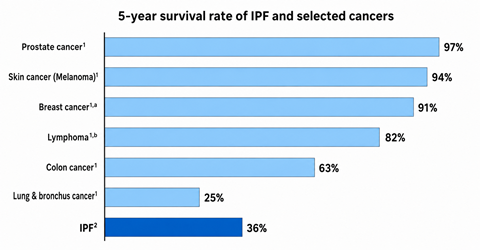
Figure 2: IPF and five-year survival of patients with selected cancers
a. Breast cancer data is only from female breast cancer patients.
b. Lymphoma data is from the average of Hodgkin lymphoma (89 per cent) and Non-Hodgkin lymphoma (74 per cent).
Cancer survival estimates are derived from US population data reported by Siegel et al. (2024)[2] , based on cancer incidence data through 2020 and mortality data through 2021. IPF survival estimates are derived from Pimple et al. (2025)[3], a real-world observational analysis of patients with IPF conducted in the United States using routinely collected healthcare data between 2014 and 2024; the reported five-year survival estimate (36 per cent) should therefore be interpreted in the context of the study population and methodology. As these estimates originate from different populations, countries, methodologies and periods of analysis, they are provided for contextual purposes and should not be interpreted as direct like-for-like comparisons.
From mortality to commissioning action
IPF is commonly misdiagnosed as chronic obstructive pulmonary disease (COPD) or asthma,[4] and despite affecting fewer patients, IPF is responsible for 1 per cent of deaths in the UK.[5] More broadly, although ILD affects fewer patients than COPD or asthma, its wider impact on healthcare services is often underestimated.[4] Patients with ILD can spend months navigating fragmented pathways, undergoing duplicate investigations and attending multiple appointments across different providers before receiving a timely diagnosis and access to specialist ILD care. This consumes capacity across respiratory services, diagnostics and outpatients while delaying access to appropriate specialist management.[4] Improving ILD pathways is therefore about more than supporting a growing patient population; it is about improving patient flow and making better use of healthcare resources across the respiratory pathway by reducing avoidable appointments, duplicate investigations, administrative burden and unnecessary demands on clinical capacity.
What commissioners can do now?
Time to Breathe identifies the following actions that aim to reduce avoidable mortality and improve pathway performance:
- Timeliness of diagnosis, earlier appropriate treatment and fewer acute presentations
- Access to specialist multidisciplinary team (MDT) review, supporting accurate phenotyping and planned care
- Allocation to a specialist ILD nurse who can help provide support, initiation and persistence of therapy, reducing progression and admissions
- Assessment of oxygen need in line with national guidance
- Timely access to pulmonary rehabilitation
- Access to palliative care services
- Access to clinical trials
Tools to support implementation
At a time of limited commissioning resources, Boehringer Ingelheim has supported practical tools to accelerate evidence-based pathway adoption:
- A costed ILD pathway can save commissioners time by providing a ready-to-implement framework aligned with national standards.
- An implementation toolkit can help systems adopt the national consensus pathway, relieve pressure on specialist centres and reduce waiting times for patients.
These tools are intended to make improvement feasible, not theoretical, by reducing the operational burden of redesign and helping systems move from aspiration to implementation.
Proof that change is possible
Despite the current commissioning challenges, NHS Northumbria Healthcare Foundation Trust showed that progress is possible. By realigning existing clinical capacity and strengthening links with tertiary expertise, Northumbria developed a tier 2 ILD service[6] – a crucial mechanism for increasing specialised capacity, reducing unnecessary tertiary appointments and bringing care closer to home.
Crucially, this was achieved without any new investment. Rather than relying on additional funding, the service was developed through the reconfiguration of existing outpatient capacity, consultant job plans, diagnostics, administration and specialist nursing support. Aside from nationally commissioned treatments, most of the components required to deliver a tier 2 service already existed within the system. The challenge was service configuration, not resource availability. By aligning existing infrastructure more effectively around patient need and MDT working, the team established a tier 2-equivalent service at no additional cost while improving access, resilience and pathway efficiency.
Time to act
ILD should no longer be treated as a niche respiratory condition. It is a high-mortality disease area where earlier diagnosis, timely MDT review, access to appropriate treatment, stronger networks and better data visibility can translate into better patient outcomes. Ultimately, this is about time: time to recognise disease, time to diagnose, time to act, and time not lost to avoidable delay.
Job bag number: NP-GB-107728
Date of preparation: September 2026
References
1. Zheng Q, et al. Mortality and survival in idiopathic pulmonary fibrosis: a systematic review and meta-analysis. European Respiratory Journal Open Res. March 2022. 2022;8(1):00591-2021 doi:10.1183/23120541.00591-2021. Accessed 20/07/2026.
2. Siegel, R.L., Giaquinto, A.N. and Jemal, A. (2024) ‘Cancer statistics, 2024’, CA: A Cancer Journal for Clinicians, 74(1), pp. 12-49. Available at: https://doi.org/10.3322/caac.21820.
3. Pimple P, et al. Impact of antifibrotic treatment on clinical outcomes in idiopathic pulmonary fibrosis. Presented at: European Respiratory Society International Congress 2025; 27 September–1 October 2025; Amsterdam, Netherlands.
4. Action for Pulmonary Fibrosis. PF State of the Nation Report 2026. Action for Pulmonary Fibrosis website. 2026. Accessed 20/07/2026.
5. British Thoracic Society (2021) BTS ILD Registry Annual Report 2021: A summary of the UK IPF Registry for the general public. London: British Thoracic Society. Available at: British Thoracic Society ILD Registry (Accessed: 6 August 2026).
6. OneVoiceILD and Action for Pulmonary Fibrosis. Interstitial Lung Disease Care Pathway 2024.April 2024. Available at: https://actionpf.org/Portals/0/page-content/documents/one-voice-ild-care-pathway-report.pdf