



















Every year, patients in England die from structural heart diseases when earlier intervention could have saved them. Treatments exist and are effective, and outcomes when patients are treated in time are good, yet the system is failing to reach people before it is too late. This is not acceptable, and it needs to change.
Sponsored by and written for
Our recently published State of the Nation report examines the current state of care for SHD patients in England. Drawing on frontline interviews with clinicians across the pathway, from GPs and echocardiographers to interventional cardiologists and surgeons, the report sets out in detail where and how patients are being failed.
Valvular heart disease (VHD) is the most common form of SHD, and aortic stenosis, which involves a narrowing of the aortic valve, has the worst mortality within VHD. Without treatment, half of patients with severe aortic stenosis die within two years, and three-quarters die within three years.
This is a prognosis worse than many cancers, yet aortic stenosis does not receive near the attention or investment that cancer care does.
Where the pathway is under pressure
The challenges are not confined to one part of the pathway for SHD. They accumulate across it and reflect the broader pressures facing the NHS rather than any single point of failure:
- Detection - many patients with VHD are undiagnosed and go undetected for years.
- Diagnosis - access to diagnostic imaging is poor and highly variable, with patients facing long waits in overwhelmed services to receive diagnoses.
- Assessment - patients face long waits and multiple appointments for specialist review.
- Intervention - patients again face long waits for treatment, with VHD procedures competing with other diseases in overstretched operating theatres and cardiac catheterisation labs.
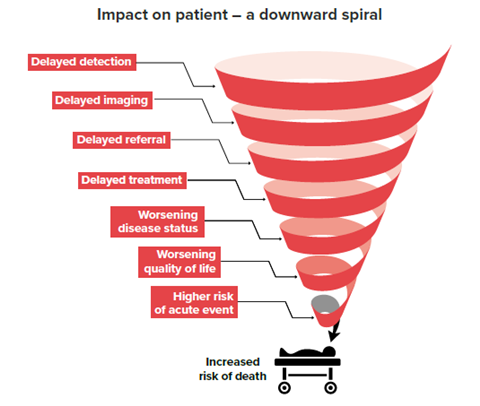
Each delay compounds the next. Patients deteriorate while waiting, and deteriorating patients are more likely to require emergency admission. Emergency admissions consume the capacity needed to reduce the backlog, making it harder still to treat patients in time. It is a cycle that cannot be broken without coordinated action across every stage of the pathway.
For patients, this can constitute an unacceptable downward spiral. Delays in getting the care they need mean worsening symptoms, reduced quality of life, a higher risk of acute events, and for too many, death before treatment arrives.
One leading clinician interviewed remarked: “The cost of not getting this right is absolutely huge… The ultimate price is that patients die – and we do see deaths on the waiting list for a condition that is entirely treatable. There is a real attrition rate: people who were stable at diagnosis wait months, decompensate into heart failure, end up being admitted, and are in a far worse state than when the problem was first picked up… So, the harm is twofold – patients come to real harm, and the NHS absorbs huge, entirely avoidable cost.”
What needs to happen
There is clear clinical consensus on where to focus. Public awareness campaigns, such as Heart Valve Voice’s “SLOW” symptoms awareness initiative, have a role in closing the detection gap and ensuring more patients are identified earlier. Access to diagnostic imaging needs to improve consistently across all systems.
Every hospital should have a dedicated valve clinic with a clear single point of access, able to triage, prioritise, and direct patients to the right care without unnecessary delay. Implementing best practice models that have demonstrated substantial, measurable improvements, such as Rapid Access to Valve Assessment (RAVA) clinics, where patients with suspected severe VHD are referred directly to specialist services, effectively eliminating unnecessary secondary care waiting times, should become standard practice across the country.
Interventional capacity also needs to increase to keep pace with current and future demand. Investing now in the ability to treat patients before they deteriorate and require more expensive and resource-intensive emergency admissions is both clinically and economically the right approach.
The opportunity to act
Preventable delays are causing preventable deaths. The pathway gaps are known, the solutions exist, and the models of best practice are there to be scaled.
To make a real difference, organisations should:
- Support national campaigns to raise public awareness of valvular heart disease and drive earlier detection
- Improve access to diagnostic imaging and interventional capacity consistently across all systems
- Review and audit local pathways to ensure they reflect the modern management of VHD
- Embrace digital technologies that can accelerate diagnosis and care
The recent publication of the Cardiovascular Disease Modern Service Framework (MSF) is a welcome step, recognising heart valve disease within the government’s strategic vision for cardiovascular care, including a commitment to improving access to aortic valve interventions. Building on this momentum, the task now is ensuring structural heart disease continues to receive the focus and priority it deserves, giving systems the platform and impetus to deliver the change patients urgently need.
Want to understand more about the current state of the nation on SHD care in England? Read our executive overview by clicking the image below: