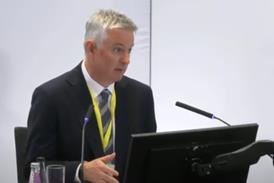

Dave West

National IT programme: stepping into the unknown

Chief deployment officer at Connecting for Health Claire Mitchell talks to Stuart Shepherd about risk taking and realism in her role

When the perceived shortcomings of the multi-billion-pound project in which you are a major player are writ large in the broadsheets and broadcast loud at the Commons public accounts committees you might be forgiven for wanting to skulk off and throw it all in.

That is not Claire Mitchell's way. The chief deployment officer at Connecting for Health, the agency delivering the national IT programme, is made of tougher stuff. Her personable, open and thoughtful manner, however, belies the kind of durability that might generate a cold aloofness in others.

When she signed up to what has been billed "the world's biggest civil information technology programme", did she know what she was letting herself in for? What are the risks you take on when you ally yourself to such a high-profile scheme? And can that kind of a rollercoaster ride really be worth it?

"At the end of 2002," says Claire, "after several years as a management consultant on IT-enabled change in the manufacturing, finance and public sectors, I had got to the point where I felt I was spending too much time on the sidelines. What I wanted was for the buck to stop with me."

Cue Richard Granger, NHS IT director general, with an approach to join, at a senior level, the team that would be tasked with delivering an IT modernisation programme on a colossal scale.

"I am quite driven by my values and a sense of service to the public, and there was a good fit here - especially working in and for the NHS, where the relationship between what you do and the outcomes is much more direct," says Claire.

"Things were still in the early stages of specification and procurement and there was clearly going to be a lot of stepping into the unknown. Far from being all bad, the advantage of that is the massive opportunity it presents to shape things as they develop."

Sudden changes

So, a job that offered a big step up and plenty of direct responsibility tempered with a lot of exposure - essentially the good and the bad of having that buck you were after pulling up right at your door.

No matter how she squared it, as Claire points out, it all came down to gut instinct. The programme looked like it would benefit from the right mix of NHS experts - with a strong sense of what the organisation was going to need - and people with previous experience on big IT procurement projects.

Claire certainly had that. She also brought a strong feel for the organisational culture she would be committing herself to. She says: "You can come into a programme and make your own assessment of the risks and base your analysis on that. The unique thing about the public sector, however, is the fluidity, the uncertainty. It is a feature of the environment and you can't let sudden changes of direction throw you off-kilter. You have to respond flexibly to them."

"Perhaps unlike some of my peers and senior colleagues, I don't need to know with certainty what will happen during the next eight years," says Claire. "I can be OK knowing the direction of travel is right, the strategy sounds good and we are taking the right steps along the path."

Despite all her weighing up, her instinctive feel for a situation and her flexibility, she has had moments of doubt. One was what she calls the darkest days of choose and book, a theme she touched on recently during a presentation on The Right Behaviours Underpin Effective Delivery at a risk management conference.

She told the audience: "Two and a half years ago when I was very much involved with choose and book, the amount of GP referrals to hospitals in England using the system stood at 9 per cent, we were having a lot of adverse publicity and I think it is fair to say that it wasn't so popular with some parts of our constituency."

She and her colleagues gathered a team of clinicians to travel the country, demonstrating a system many people had not seen before, and calming a lot of nerves.

The incremental achievements that come with moving a programme on, maintaining the momentum and getting it ever closer to delivering the full benefits help answer some of the "milestone" questions that come with such a long-term project - is it worth the energy? Am I making a difference? How am I impacting on the end result?

"For the last year," says Claire, "I have been involved with the local service provider contracts. The fact that some of our suppliers are struggling to deliver on these has been very transparent. In a situation like this you have fundamentally got to believe that in the end the strategy will work."

Acid test

Claire has had to take some of the hits the national IT programme has been dealt on the chin. Deciding how much of that to stick around for was a personal choice, but still worth the kind of consideration that got her there in the first place.

"You are certainly going to want to know that you are valued," says Claire. "It also pays to be attuned to what the future holds for the organisation. The real acid test though is how much you feel you have got left to give in that kind of environment and whether effort matches the outcome.

"It is a personal thing. For me this has been less about working for Connecting for Health and more about delivering the end user benefits of the national programme for IT. While I can continue to deliver and it still engenders a passion, I have a reason for staying engaged."

Readers' comments (1)

  • One of the questions I would raise is how high level managers, such as Claire, were briefed or investigated the business processes of the organisations they were employed to reform?
    I remember that RG did not know that IT was central to the care of patients in General Practice long before NPfIT came along to bring the NHS into the new age of IT - and plans and contracts awarded appeared to be based on the misconception that there was a uniform green field for development of IT throughout the NHS.
    Must say that, as an end user GP, I hadn't heard of Claire previously...

    Unsuitable or offensive? Report this comment

Have your say

You must sign in to make a comment.

  • Email
  • Comments (1)
  • Save

Related images

  • Email
  • Share
  • Comments (1)
  • Save

Newsletter Sign-up

More Newsletters

Resource Centre

Practical solutions to today's key management challenges.

Click here