











Nicholson argues he should survive to implement Mid Staffs recommendations
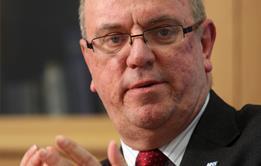
NHS Commissioning Board chief executive Sir David Nicholson believes he should survive any criticism levelled at him by the forthcoming report into care failings at Mid Staffordshire Foundation Trust.
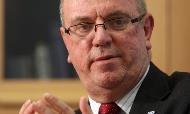
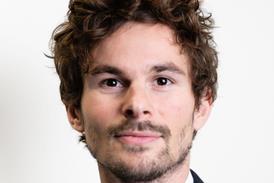
Source: Gabriel Szabo, Guzelian
In an exclusive HSJ interview he also said he hoped to hold his new position for “the next few years”. He added: “I can see a whole load of things that I need to do.”
Sir David was chief executive of Shropshire and Staffordshire Strategic Health Authority during 2005 and 2006. He appeared in front of the inquiry for two days. The inquiry’s counsel Tom Kark said Sir David’s insistence that the care failings at Mid Staffordshire were not indicative of a “systemic” issue was a “dangerous attitude”. His declared reliance on the regulatory system to spot poor performance across the NHS was described as “naive” by Mr Kark.
Julie Bailey, who founded the campaign group Cure the NHS after being appalled by the care she witnessed her mother and others receive at Stafford Hospital, told The Daily Telegraph on Monday that: “Sir David needs to stand down immediately if he has got any conscience – he has stood by and watched hundreds of people die.”
Robert Francis’ report into Mid Staffordshire is due to be submitted to the Department of Health this month and is likely to be published in mid-February.
Sir David, who also holds the position of NHS chief executive until the end of March, told HSJ: “I haven’t seen the Francis report, I haven’t seen a leak or anything of the nature.” However, asked if he was considering his position, Sir David said “nothing I’ve seen” to date would made him feel it was under threat.
Mr Francis was required to send letters to anyone criticised in the inquiry. The board chief executive stated he been required to sign an undertaking not to discuss any letters “he may or may not” have received from the inquiry.
Sir David said: “Other people will decide [whether I keep my job], but from my perspective I can see a whole load of things that I need to do.”
He revealed that, “If I ever did think about” resigning it was in the wake of the publication of the initial private inquiry into Mid Staffordshire, also conducted by Mr Francis. Sir David spent a weekend reading the “patient stories” included in the report, something he described as a “completely salutary” experience.
However, he added: “Francis will challenge us around the culture of the NHS, he will challenge us around patient voice, he’ll challenge us about basic quality – I think I’ve got a big contribution to make to make all of those things better because of the experience and understanding I have.”
Sir David also dismissed a persistent rumour that he had taken out an injunction challenging the inquiry’s criticisms of his actions. He said: “I absolutely never would and have never made any kind of threat of doing it.”
The commissioning board and NHS chief made a detailed case for his role in improving patient quality in the past and future.
He said: “When I applied for the job of chief executive of the NHS [in 2006] it was in a particular set of circumstances. My pitch for the job was that NHS leadership had lost its focus, the purpose of why we were there. We got so excited about the technical changes that were going on that we missed out what we were trying do – which is to improve services for patients.”
Sir David claimed the work he led in the subsequent years, such as setting up the national quality board, lead to a “point in 2010 when the NHS was delivering all things it said it would deliver, we had a £1.5bn surplus, we had the best patient satisfaction we’d ever had and public confidence was at an all-time high”. Despite this he claimed all “still wasn’t right” with the NHS.
Two issues remained unresolved. The first was the need to deliver £20bn worth of efficiencies by 2015. “It seemed to me that I was in the best place to see that through to the conclusion”, he said. The other issues he said was the need “to give patients more clout - that is the unfinished business for me”.
He continued: “As chief executive of the NHS a lot of my legitimacy comes from the fact that I am accountable to an elected politician. In the new world the legitimacy of the commissioning board comes from the legislation. But that in itself will never shift anything.
“It struck me right from the beginning that the commissioning board’s legitimacy needs to come from its connection with patients and the public. That’s why we structured the commissioning board around the five domains of the outcomes framework and created the patients and information directorate. The commissioning board should know more about what patients were thinking and feeling.”
Visit www.hsj.co.uk over the coming days to read more from our interview with Sir David Nicholson
View results 10 per page | 20 per page | 50 per page |
Have your say
You must sign in to make a comment.


Readers' comments (83)
Anonymous | 10-Jan-2013 7:44 pm
Not just Nicholson, but also all his hand-picked yes-men (and women ) who have been eased into senior positions duuring the current reshuffle without proper transparency or accountability around the process should go, as they carry the same blameless complacency culture. This is not brass neck, it is a delusional psychosis. agre with the majority of previous comments - how will outcomes ever improve when the same incompetents are shuffled around posts, with uselessness being rewarded by promotion?
When is anyone going to have the guts to challenge the emperor's new clothes of the fictitious £20bn QIPP agenda - this figure is not based on realistic accounting, and there has been no evidence to date of any significant reinvestment of the monies scrimped and saved by reducing patient care back into the health economy. So much for CCGs taking control of the service and addressing local needs - the same dead hands as before have got the NHS by the larynx and are squeezing any life or true practice innovation out of it.
Time for a Stalinesque pogrom of the entire politburo.
Unsuitable or offensive?
Anonymous | 10-Jan-2013 8:43 pm
You have sat too long for any good you have been doing lately ... Depart, I say; and let us have done with you. In the name of God, go!
Unsuitable or offensive?
Anonymous | 10-Jan-2013 8:49 pm
I have now been working in the NHS as a finance consultant for nearly 3 years. I’m afraid to say that this is an example of the attitude and arrogance of executives throughout the country. It is usually coupled with incompetence and nepotism ensuring that this system is maintained and continues to operate as an ‘establishment’. This is why the NHS is crumbling and inhibits any meaningful and sustainable reform. When are we going to do something about this and get these overpaid fools out of these jobs so we can ensure that the NHS doesn’t become too broken to repair.
Unsuitable or offensive?
Rachel Coaker | 10-Jan-2013 8:51 pm
I have now been working in the NHS as a finance consultant for nearly 3 years. I’m afraid to say that this is an example of the attitude and arrogance of executives throughout the country. It is usually coupled with incompetence and nepotism ensuring that this system is maintained and continues to operate as an ‘establishment’. This is why the NHS is crumbling and inhibits any meaningful and sustainable reform. When are we going to do something about this and get these overpaid fools out of these jobs so we can ensure that the NHS doesn’t become too broken to repair.
Unsuitable or offensive?
MVMG | 10-Jan-2013 8:53 pm
Anon 8.49 as you have remained anonymous I assume you are concerned that the same arrogant, incompetent and nepotistic executives won't employ you any more at consultancy rates.
Unsuitable or offensive?
Anonymous | 10-Jan-2013 9:11 pm
Time to spend more time with his family?
Unsuitable or offensive?
Anonymous | 10-Jan-2013 9:12 pm
I have never such a lack of accountability in my life
As a whistleblower raising serious concerns regarding patients outcomes, safety, quality and expoeirence
The management did want to know
Where was the 5 domains...safety, expeirence...
Where was the 5 c's in nursing care
What happened to me ...
The same bullying culture remains
The bullying is not tackled
managers have no accountability
Senior nursing and medical staff stand by and do nothing
The poor care goes untackled
No transparency and duty of candour.. whats that about
I have to leave the hospital and get completely shafted
There will never be any lessons learned and nothing will ever improve
Mid staffs will happen over and over again and good staff will be burnt out
I hope Nicholson is pushed out... but pigs might fly as well
Unsuitable or offensive?
Anonymous | 10-Jan-2013 9:25 pm
So his defence is that because he was involved he should be allowed to stay to address the problems
Unsuitable or offensive?
Anonymous | 10-Jan-2013 9:38 pm
Methinks the man is rattled........
Unsuitable or offensive?
Anonymous | 10-Jan-2013 10:06 pm
If I was advising him I would tell him to go now while he still has a choice
Unsuitable or offensive?
Anonymous | 10-Jan-2013 11:43 pm
Is this the NHS equivalent of the Romanian revolution with DN playing Nicolae Ceausescu?
Unsuitable or offensive?
Anonymous | 11-Jan-2013 10:23 am
how do we get this passionate commitment to change transferred to the government web site where we can demand that this be addressed in Parliament?
Unsuitable or offensive?
Anonymous | 11-Jan-2013 1:37 pm
I would like to think that David N has read all of these comments and acts accordingly. Of course most people will respond anonymously, because there is no safety for anyone who criticises those above. Managers and staff are afraid of rocking the boat. Jeremy Hunt's duty of candour has to protect anyone who makes criticisms.
Unsuitable or offensive?
Anonymous | 11-Jan-2013 1:39 pm
This is and never has been about one man- this is about a system and the need for systematic change. As a young NHS manager I am not that interested in heroic leaders to me we ALL have a lot of work to do. So we get rid of Nicholson and we will all look for the messiah to come and save the NHS? It's up to all of us, so quite frankly lets push for the change we want and know has to happen and stop looking to the top for answers. If he resigns- what will change exactly?
Unsuitable or offensive?
Anonymous | 11-Jan-2013 1:59 pm
Can't say I know anything about Sir David, the bullying I have seen has come from senior managers in my own organisation. It does strike me that he's a convenient scapegoat for the Francis report when most of the problems are a result of meddling by politicians namely Burnham and most definitely Lansley who IMHO should face corporate manslaughter charges.
Unsuitable or offensive?
Mark Newbold | 11-Jan-2013 2:24 pm
Anon just above (1:39) - well said, wise words for a youngster. Whoever you are we need more of you!
Unsuitable or offensive?
Anonymous | 11-Jan-2013 2:57 pm
Be careful what you wish for. Lots of comments here about the wider service, specific organisational bullying and care failures. Fair enough, great that everybody gets to have their say even if, for a huge variety of reasons, we choose to do this anon. But, ask yourself what happens next? If he goes, and there is a power struggle at the top, at this key and crucial time - who replaces him? Will they be any better? Could they be worse? Mid Staffs, Winterbourne et al will continue, but not because of one or two or even a dozen leadership bods. They will continue until people managing the system (and I'm guessing thats a lot of us typing/commenting here) actually get a grip and challenge, hold to account and change the system. If we're not prepared to do that - do we really have the right to snipe to the degree we are? There is a tremendous amount of work to do. Lets concentrate on doing that, with strong leadership at all levels, which, sometimes needs a degree of grip and control, something sadly lacking at Mid Staffs.
Unsuitable or offensive?
Anonymous | 11-Jan-2013 3:49 pm
Independence is really important in demonstrating the credibility of actions taken after these inquiries.
Too many NHS issues have been inadequately investigated and followed up by people who are far too close to the problem.
I don't think the politicians or public will stand for this any longer.
Unsuitable or offensive?
Anonymous | 11-Jan-2013 5:09 pm
It is time to issue a reverse of the "Nicholson challenge".
So here is a challenge to Sir David.
Sir David: if you believe that staff have a duty to raise concerns about patient welfare or financial probity when they arise, and if you believe that all NHS managers should subscribe to the Nolan Principles of openness and accountability, then you must demonstrate this by waiving all "confidentiality agreements" where these have been imposed on whistleblowers to buy their silence when they have left the NHS. Let those who had concerns tell their stories without fear of retribution so that the truth can be tested and lessons learned.
Then you must identify and discipline every NHS manager who requested and countersigned such agreements - their values and attitudes are clearly inappropriate and unsafe. Protecting the public must be more important than protecting you or ministers from embarrassment (or in extreme cases concealing illegal acts).
And then you must resign, because these clauses were imposed in your name and with your tacit or overt consent.
You should stay just long enough to institute a regime of truth and reconciliation, and then you should go.
You are not fit to fix what you broke.
And you must not take a penny in public money on your way out, nor ever work for the public sector again, unless it is in a voluntary capacity (take your cue from John Profumo).
That is our challenge to you.
Unsuitable or offensive?
Daphne Havercroft | 11-Jan-2013 8:08 pm
Unless it is tweaked following the Francis report, the future is already laid out in the Draft document “Quality in the new health system – Maintaining and improving quality from April 2013.”
It was produced by the National Quality Board – membership - Monitor, CQC, GMC, NHS Trust Development Authority, NICE, Health Education England, Department of Health and chaired by David Nicholson.
It says "the leadership within organisations who provide care remains ultimately responsible for the quality of care being delivered by their organisation, across all service lines".
So if you are a leader of an organisation which is sitting on a health scandal, bearing in mind the words of Robert Francis “There is a tsunami of anger heading towards the NHS which will overwhelm people paddling in their canoes acting as if nothing is happening", you are going to do the decent thing, accept responsibility and fall on your sword, right?
Someone's got to go and your beloved leaders at the top of the NHS and the regulators obviously think the buck should stop with you. That won't change until they are replaced with people who have the right culture to lead the NHS and cut out the bullying.
Unsuitable or offensive?